
Marketing has one job:
To be remembered. To occupy a space in someone’s head so that when a decision moment arrives, your name is already there.
So that when a decision moment arrives, your name is already there.
If your marketing is ignored, nothing else matters.
Your data can be accurate. Your message fully approved. Your design perfectly on brand. All of that effort still fails if it does not do the one thing marketing exists to do.
Correct communication dominates life science
B2B communication in life science is all about being correct. Factually accurate. Compliant. Internally aligned.
And safe.
That sounds responsible but it also creates a serious problem: it doesn’t create any real impact
Correct communication rarely leaves a mark. It struggles to create recognition, recall, or preference in markets where attention is scarce and choices are slow.
Teams spend months refining language to remove risk. Claims get softened. Statements get qualified. Sentences get polished until they are impossible to object to. The outcome is careful and balanced. Hard to disagree with. But also, impossible to remember.
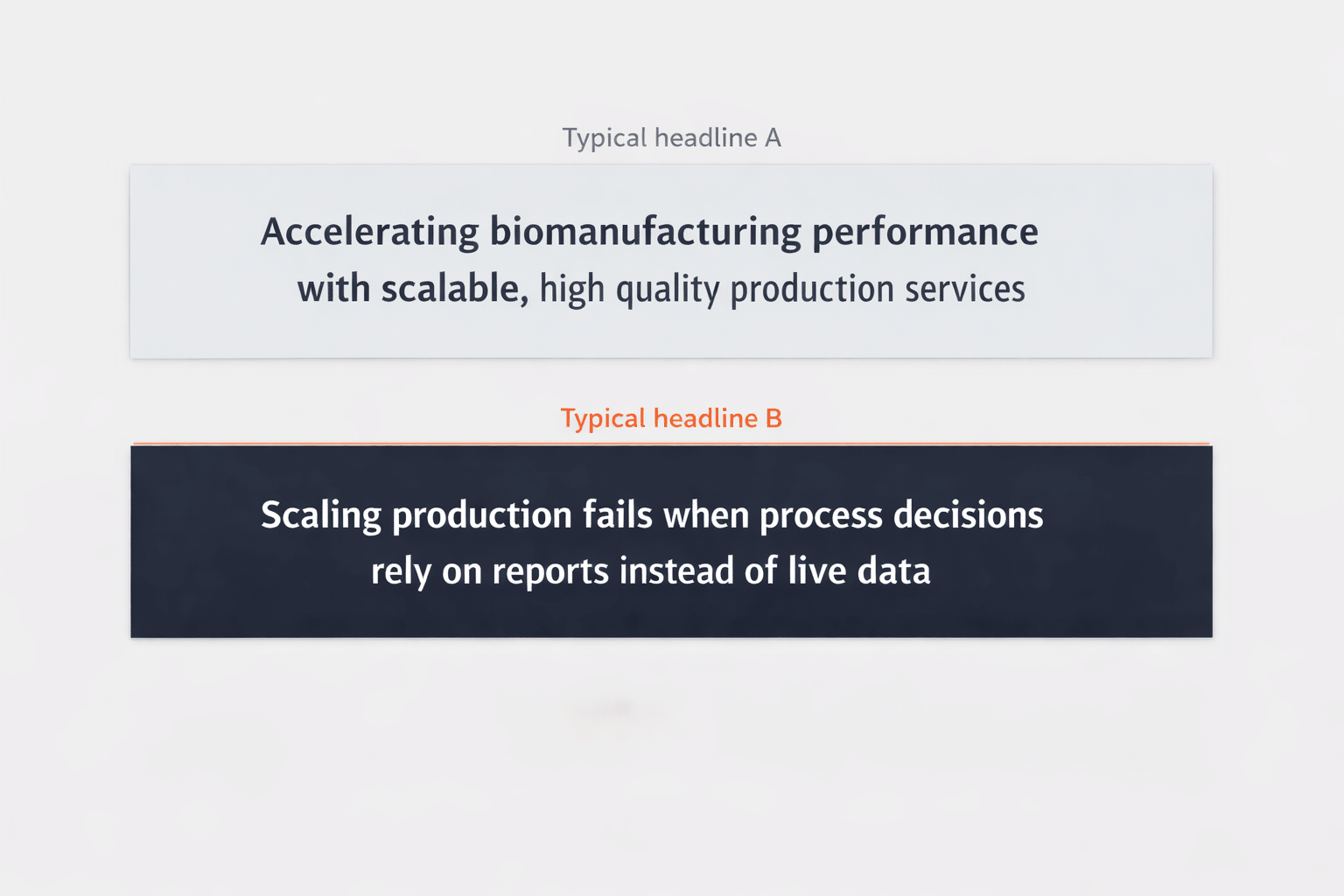
Both headlines are accurate. Both would pass internal review. But one describes capability in a way everyone else does. The other signals belief and direction.
Sameness is not an accident.
Research shows that the strongest B2B brands are not just different on paper, they are distinctive in how they are recognised and recalled by buyers, because distinctiveness builds mental availability rather than generic similarity.
Recent industry surveys find a large share of B2B buyers say many brands sound alike and struggle to recall them, creating a barrier to choice.
Brand recall research shows that when buyers cannot bring a brand to mind without prompts, it fails to influence decisions, even if the product is relevant.
And when buyers are listening, they are not paying as much attention as we think.
Gartner shows that B2B buyers spend only 17% of the buying journey meeting suppliers. The rest happens without sales involvement and without explanation.
Your communication has to work alone.
And if your message is blend, it disappears long before it has a chance to influence any decision.
At the same time, McKinsey shows that emotional factors account for more than half of B2B brand loyalty, even in highly regulated and technical industries. Buyers evaluate risk and logic, but they also rely on memory, trust, and familiarity.
B2B buyers are human(!!!) . Most B2B communication speaks as if they are not.
Being ignored is the real risk
Many organisations obsess over the risk of saying the wrong thing. Legal risk. Regulatory risk. Reputational risk.
Far fewer address the larger commercial risk of being ignored entirely.
Ignored marketing creates no memory, no preference, and no impact. It does not move decisions forward or shape how a brand is perceived. It cost money (sometimes a lot) and then simply vanishes.
Reaction comes before recall
People remember what triggers a reaction.
A surprise, a recognition, or even some discomfort. Something that makes them pause instead of scroll.
If a message triggers nothing, it leaves nothing behind.
The internal approval loop strips ambition
Most teams recognize this pattern instantly.
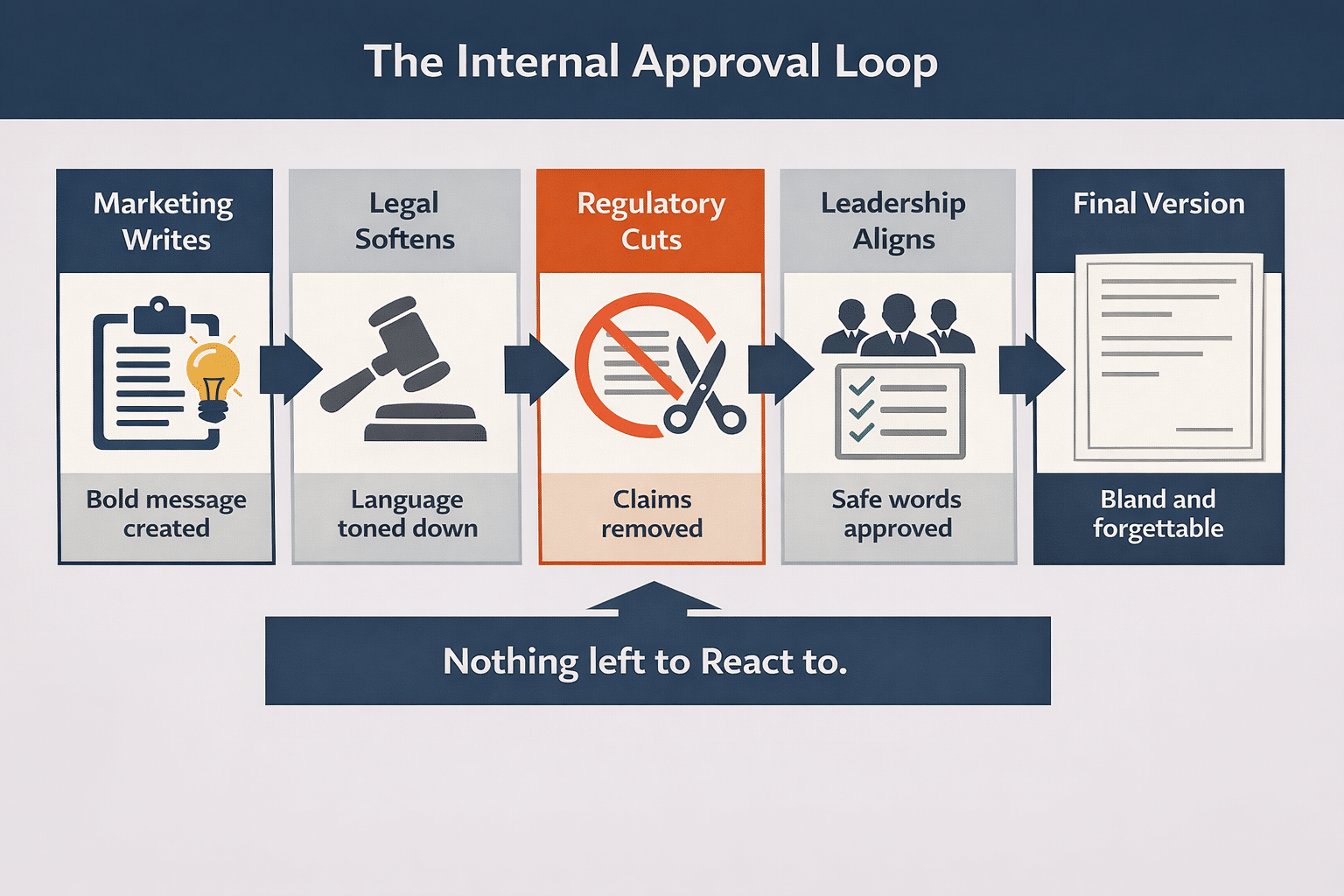
No one in this loop is acting irresponsibly but the outcome still fails to do the job marketing is meant to do.
Correctness feels responsible and professional. It is defensible. But it is also very convenient, because it’s safe.
“We cannot say that.”
“Our buyers are rational.”
“Our industry does not allow strong language.”
These statements are rarely about regulation alone. More often, they signal hesitation and a desire to be acceptable to everyone rather than meaningful to someone.
Ambition in communication is not about breaking rules. It is about making decisions.
One golden rule: a maximum song length of 1 minute 45 seconds. If a song exceeded that, we would regenerate it.
In the admin tool, a human marked the rap IN and OUT points. From there, the system calculated how much intro, main footage, and outro to use.
Correctness is the baseline, not the ambition
Accuracy matters. Compliance matters. Precision matters.vThey are the minimum requirement, but not the finish line.
Brands that succeed go further. They become memorable. They occupy mental space. They show up when buyers think about a category, not because they explained everything, but because they left a clear impression.
Luminous brands get remembered
Brands that are remembered are luminous. They shine.
Not because they are louder or more frequent, but because they are clearer and more defined. They create contrast in categories full of careful, neutral language. They feel present instead of interchangeable.
Luminous brands have a point of view. They make priorities visible. They accept that definition creates edges, and that edges are what memory attaches to.
This is where many life science B2B brands struggle. Their communication is technically solid but visually and verbally weak. It blends into the background at the exact moment it needs to stand out.
If your brand does not shine, it gets lost among others that sound just as correct.
And in markets where attention is scarce and decisions are slow, being lost is the one risk you cannot afford.

Let’s create something magical together.
Related Work

August 26, 2020 | 2 min read
What developers do when they are bored

March 5, 2025 | 1 min read
Luminous Minds – Ville Engberg, VOTO

September 7, 2023 | 4 min read
Come on Barbie, let’s go viral – How did the Barbie movie marketing succeed?

September 15, 2026 | 7 min read