
The slide said: “The problem we’re solving.” The founder looked at it briefly. “Let’s move on to the science,” he said, clicking to the next slide.
What followed was excellent science: proteins, signaling pathways and years of research condensed into a few minutes. It was clearly the part he knew best and wanted to talk about.
This happened in Oxford, during Venture Road UK, five days of meetings and discussions with researchers, founders, investors and life science companies across Cambridge, Oxford and London. Scientists and founders are naturally most comfortable talking about the science. So explaining what that science means to someone outside their field is a different job.
And it can be surprisingly difficult.
Scientific proof and need
In Venture Road UK Nugget #1, Nicolas Puljic from Lonza describes a gap he sees when founders communicate their work. They understand the science and the patient need, but connecting the two for someone else is harder. As Puljic puts it, the difficulty is ‘translating the scientific proof to a need.’
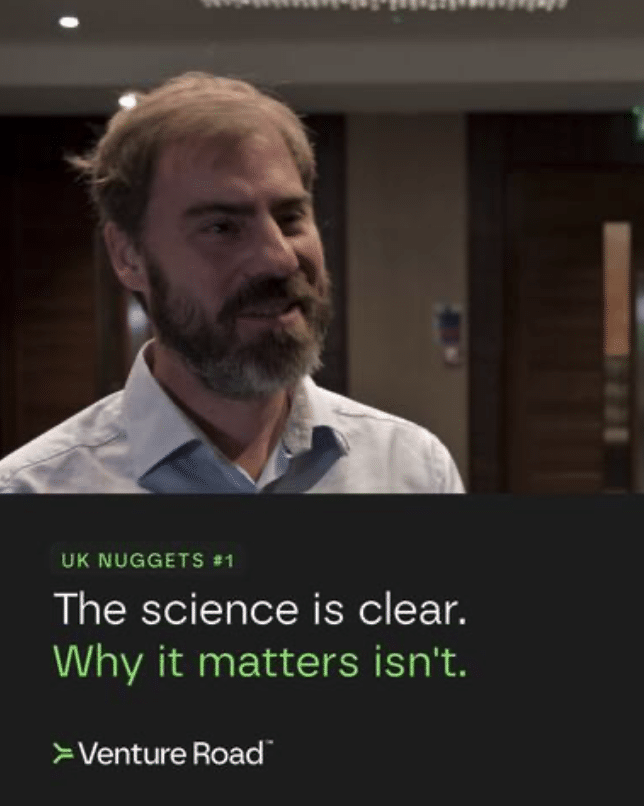
A founder can explain the scientific evidence in detail, but the person listening has a different question: why does this matter to me? The connection feels obvious to someone who has spent years on the science. It rarely feels obvious to an investor, customer or partner meeting the company for the first time.
When the technology does many things
In Venture Road UK Nugget #2, Sanna Wallenborg from Lumito describes another problem. Lumito’s technology can be used with different tissues, biomarkers and applications. That breadth is one of its strengths, but it also makes the company harder to explain.

Life science is already difficult to communicate even when a company focuses on one disease or one clearly defined problem. A technology with several possible applications adds another layer of difficulty.
Describing everything the technology can do makes it harder to see where its strength actually lies. Communication therefore requires choices, and often the hardest choice is deciding what to leave out.
Scientific presentations tend to include a lot of detail for good reason. In science, those details can be essential to understanding the evidence. But communication, and especially a pitch, comes with a severe constraint: time. You cannot explain everything.
That means removing information that is correct, relevant and important. For someone who has spent years working on the science, this can be extremely difficult. Leaving something out can feel like weakening the argument or giving an incomplete picture.
We see this constantly at Phosworks. Teams rarely lack things to say about their science. The challenge is choosing what the audience needs right now.
As Wallenborg puts it: “You need to work a bit on that story.”
Who are you talking to?
But once you accept that you cannot say everything, another question follows: how do you decide what stays and what goes?
In Venture Road UK Nugget #3, Bita Sehat from Trill Impact Ventures asks a simple question: “The thing is, the communication is for whom?”

The audience helps determine those choices. An investor may want to understand the opportunity, the risk and what it will take to reach the next milestone. A pharmaceutical partner may be interested in how the technology fits into an existing development process. A regulator will approach the same science from yet another perspective. The underlying science has not changed, but the type of details each audience needs from the conversation has.
Sehat’s point also extends beyond investors and business partners. Life science ultimately affects patients and society, yet much of its communication takes place between specialists. Sehat argues that the industry needs to become better at communicating with a public that can be critical of both science and the pharmaceutical industry.
Start from benefits and trust, not mechanism of action. A member of the public is unlikely to look at a new technology through its mechanism of action, its investment case or its development pathway. The questions will instead be about benefits, risks, trust and why the technology should exist in the first place.
The details you include should be determined by the audience. Understand what matters to them, what they already know and what they need from you, and build the communication around that. Communication is always about the audience.
What investors are listening for
In Venture Road UK Nugget #4, Reuben Isbitsky from St John’s Innovation Centre in Cambridge makes an interesting observation:
“The technologies are amazing. And the first thing I tell them is, I’m not really interested.”

In the next sentence, Isbitsky admits that personally, he is very interested in the technology. Professionally, however, he has to look beyond it.
In Cambridge, that makes sense. By the time a company coming out of that ecosystem is sitting in front of investors, strong technology is often taken as a given. There is world-class research, strong intellectual property and highly qualified people behind many of the companies investors meet.
Yet founders often continue to focus heavily on proving and explaining the science. It is understandable. They may have spent years, sometimes decades, working on it. They know every detail, and the science is often the reason the company exists in the first place.
But the investor has moved on to other questions. Who are the people behind the company? Can they build relationships with investors and customers? Do they understand the market they are entering? Can they explain where they are going with the technology?
That is what Isbitsky is getting at when he says he is “not really interested” in the technology. He is not dismissing the science. In his environment, strong science is already expected. What differentiates one opportunity from another may instead be the people, the business and their ability to take the technology forward.
And that takes us back to the founder in Oxford who wanted to skip “the problem we’re solving” and get to the science. For him, the science was the centre of the story but for the people he needed to convince, it was only one part of it.
The science stays the same. The audience doesn’t
So what should a life science company do? “Make it simpler” sounds like the obvious answer, but it misses an important part of the problem.
Scientific communication still needs to be accurate, and sometimes the complexity is necessary. The real challenge is deciding what needs to be understood in a particular situation. A five-minute investor pitch cannot contain the same level of detail as a scientific presentation. A conversation with a potential partner will focus on different things than a conversation with patients or the public.
This is something we work with regularly at Phosworks. The difficult part is rarely finding more things to say. Life science companies usually have more than enough material. It comes down to deciding what the audience needs to understand: which parts of the science matter, what can be left out and, sometimes, when the conversation needs to move beyond the science altogether.
Understanding the audience comes first, before deciding what the communication should contain. An investor, partner, customer or member of the public will come with different questions. Answering those questions does not mean compromising the science. It means making clear why the science matters to them.
The science stays the same. How you communicate it has to change.